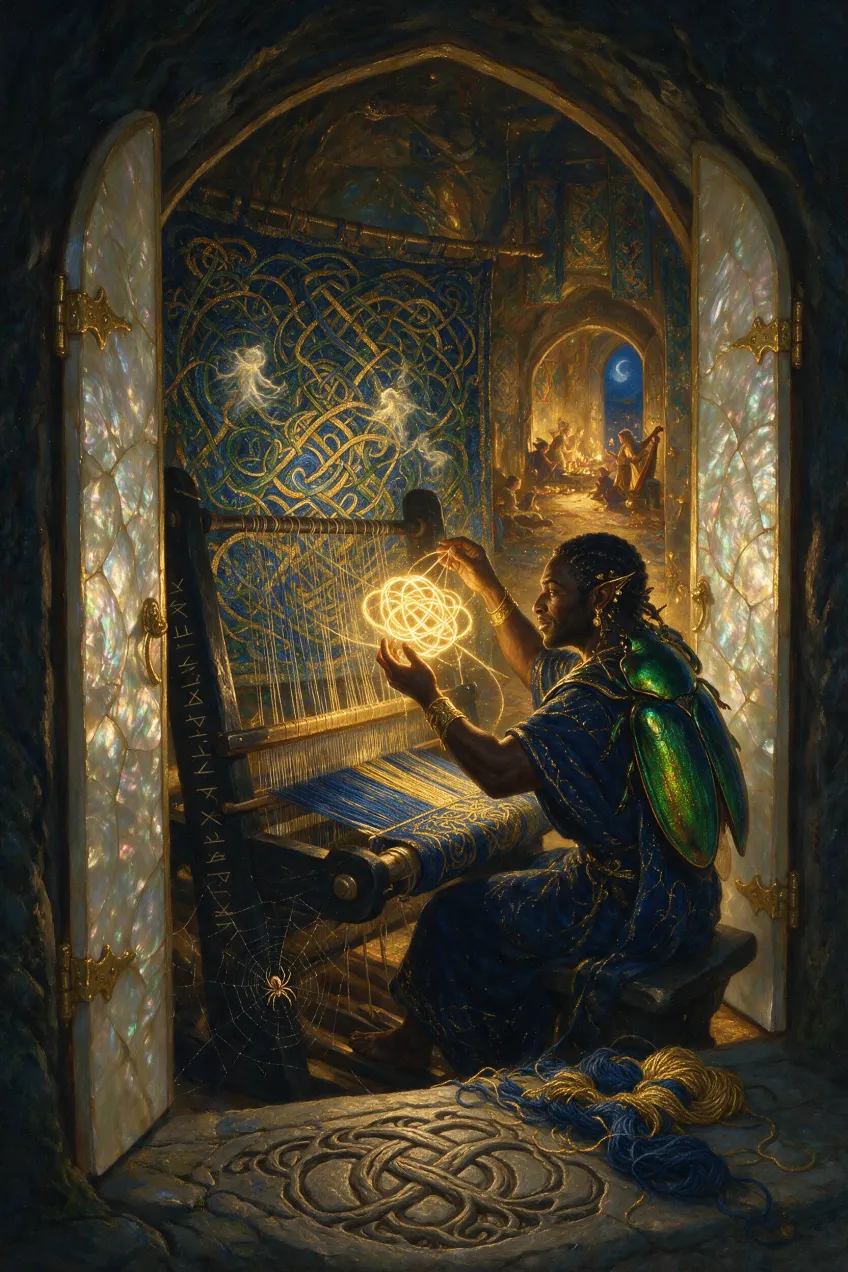
Knotkeeper
A line with no loose end cannot be picked apart. Neither can a promise kept whole.
Who they are
The master-weaver of the Hollow-Hill hall — indigo and gold against warm dark skin, beetle-wing iridescence at his shoulders, hands quick as spiders. Between those hands a living endless-knot burns mid-air, and behind him the great doorway of the hall hangs with his tapestry of interlace. The endless knot is the Otherworld's own lock: a trespassing spirit must trace every line it crosses, and a line with no end tangles it forever — which is why the old people carved interlace on lintels, well-arches and cradles. Three wisp-spirits hang snarled in his weave, still trying. He guards nothing with walls. He guards with the unbroken line — a boundary kept, a word kept. To him they are the same thing.
Drawn upright — the teaching
Draw a clean line around what's yours and keep your word like it's law — that is a boundary no one can pick apart. Not the loud kind, redrawn every argument. The quiet kind, with no loose end for anyone to pull.
The working
Take a length of red wool — the warding colour, the rowan's colour. Lay it in a single closed loop around something that stands for what you're protecting: the photograph, the house key, the ring. (Chalk an unbroken knot on the doorstep if thread won't do; trace it in your mind if you're far from home — but mean it.) Then say, once, what may not cross the line: "My evenings." "My peace." "My name in that house." And then keep your word about it — that is the entire power of the knot. The line only holds while it is unbroken, and you are the line.
Drawn reversed — the shadow
Your walls have gone so high you can't get out either. Always guarding, always braced — you've made yourself the prisoner and the jailer both, and you're calling the cell "boundaries."
The undoing
Find one thread of the knot and cut it open — on purpose, with iron; scissors count. Name the person as you cut: "This gap is for you." One trusted person, through the gap, all the way in. Leave the opened cord where you can see it, so you don't quietly re-tie it by Thursday. A boundary with no door isn't protection; it's a cell you built yourself — and the rest isn't ritual, it's nerve.
Its tree · the ogham
Muin — the bramble-vine. The trailing line that binds the whole hedge together — and, left untended, strangles everything it holds. Same line, two fates. The difference is tending. Which is his entire sermon.
Sit with this
When did someone last get all the way in? If you have to think hard about it — that's your answer.