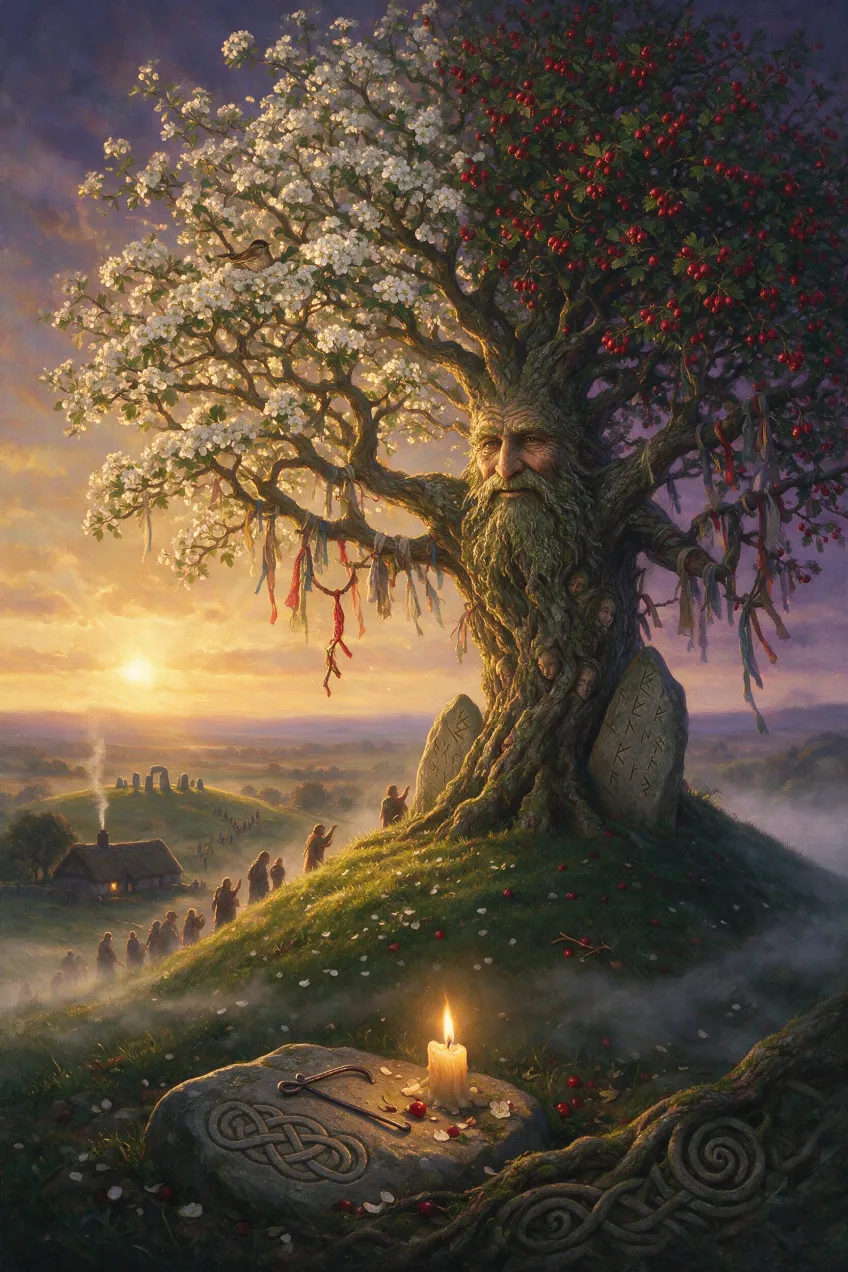
Old Man Hawthorn
They bent a road around one of mine within living memory. Tell me — what has your hurry ever bent around?
Who they are
The fairy-tree himself, given legs and barely using them — gnarled as his own trunk, lichen-bearded, wingless. He is THE lone hawthorn on the green mound, spring blossom on one bough and Samhain haws on another, holding the whole year at once. No tree in the old country is more protected by pure belief: the lone thorn is the Good Neighbours' own, and the record is blunt — fields plowed around them, roads bent around them within living memory, because no farmer who'd heard the stories would price the cutting. The rag-cloots in his boughs are generations of asking. The bent pin at his roots is somebody's ward, left in payment. He does not chase anyone. He stands, and the wise adjust their plans.
Drawn upright — the teaching
There's something old and sacred in your life — a tradition, an elder, a marker you were told to leave standing — and it is still holding more than you know. The Sunday call. The grandmother's rule. The old way of doing it that looks inefficient right up until you see what it was quietly preventing. Honor it, leave it be, and it quietly keeps watch over you.
The working
Go to the hawthorn — the fairy-tree — or to the oldest sacred thing you can reach. Tie a ribbon or a rag to it, natural cloth that can rot, for as it weathers the honoring settles in. Name aloud the old thing you honor: the person, the practice, the place. Then leave it be — the whole rite is honor, and hands off. No pruning it, no improving it, no moving it somewhere more convenient. And keep the old house-rule: May blossom stays outside the door — some honors are paid standing in the weather. Bless as you go: "Blessings on the old thorn and all it keeps."
Drawn reversed — the shadow
Tear down a sacred thing just to tidy up or move faster — sell the old home, break the last rule that held the family, cut the tree because it was in the way — and the fallout is swift and ugly. Some things are protected for a reason, and the reason doesn't explain itself twice.
The undoing
Go back to the fairy-tree — or to whatever you tore down: the person, the practice, the trust — and hang a cloot in apology. Name what you disturbed, out loud, and put right what can still be put right: restore it, return it, stand it back up. You'll pay more than you saved — that part is already true. But a true amends is heard. The Good Neighbours forgive the one who comes back. It's the one who shrugs and keeps driving they follow home.
Its tree · the ogham
Uath — the hawthorn. The letter of dread — "the blanching of faces," the old kenning — because the whitethorn is beautiful in May and absolutely not to be touched, and the fear is the respect. Sacredness with consequences. (Straif, his blackthorn hedge-kin, stands close behind him on the card.)
Sit with this
What old thing have you been treating as an obstacle? And what did you already tear down that you need to go back for?