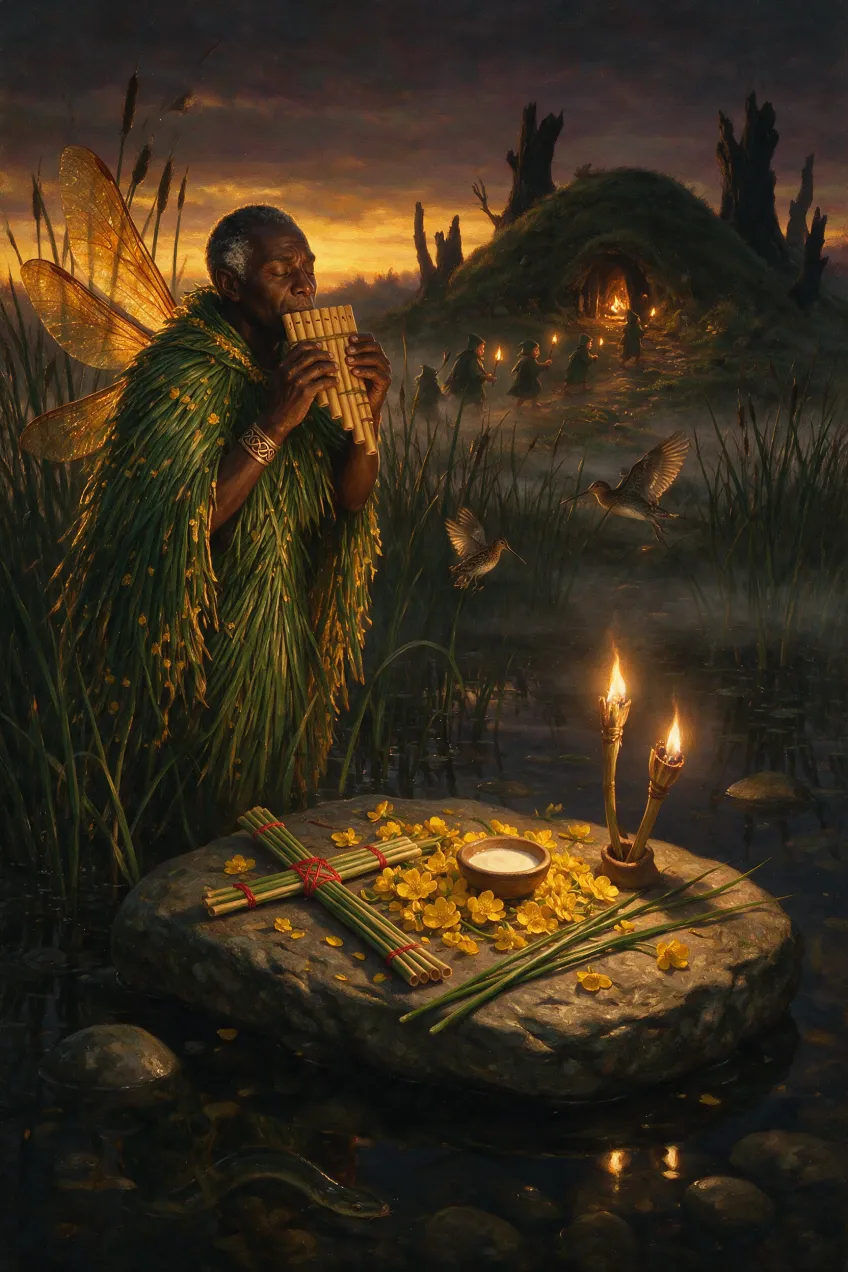
Reed-Piper
I play what you cannot say. It isn't kindness — it's how the dead get to sleep.
Who they are
A tall, warm-eyed fae in a cloak of reeds, marsh-marigold gold against his dark skin, dragonfly wings the color of peat-amber, pipes cut from the bog-reed in his hands. His office is the oldest music there is: grief. The old country never left mourning to chance — it kept the caoineadh, the keen: women whose work was to stand at the wake and give the loss a full voice, wild and formal at once, so the grief moved through the living and the dead could be let go. The church spent centuries trying to ban it; grief that loud frightens institutions. It never frightened the fen. He stands at the ancestor-stone at the water's edge at Samhain dusk and plays what the family cannot say — and downstream it goes, where sorrow is supposed to.
Drawn upright — the teaching
Give your grief a voice and the sorrow finally starts to move through you. Plainly: the loss you have been managing silently — the death, the divorce, the friendship, the life you didn't get — needs sound. Said, sung, sobbed, written and read aloud: heard. Mourning that is voiced becomes something you can carry. Mourning that is swallowed becomes something that carries you.
The working
Cut a reed by the water — or take up whatever your reed is: the pen, the guitar, your own voice in the parked car. Go to the ancestor-stone if you have one; any old stone by moving water will stand in. Then play, or hum, or say the loss aloud — its name, what it was to you, what went with it — and let the sound carry it downstream — water takes what is given at its edge. Do it badly. The keen was never pretty; it was true, which is a taller order. Let it be heard — by the water, by a friend, by the stone — and the sorrow starts to move.
Drawn reversed — the shadow
There is grief — and then there is the song you won't stop singing because it has become where you live. Mourning that never ends isn't devotion anymore; it's a hiding place, and it won't let what you lost rest, and it won't let you either.
The undoing
Play the loss through one last time at the water — all of it, the whole song, no verse skipped. Then lay the reed down on the altar-stone and let the silence come. Don't fill it. The silence after the keen was always the point: it is the sound of the grief having been fully said. Honor what you lost by finishing the song — not by living inside it.
Its tree · the ogham
nGetal — the reed, his own. In the old tree-alphabet its meaning is given as "a physician's strength" — the healer's letter — and the reed earns it: it only sings because it is hollow. What grief has hollowed out in you is not damage to hide. It is the bore of an instrument.
Sit with this
What loss have you never once said out loud, start to finish? And who could bear to hear it — the stone counts.