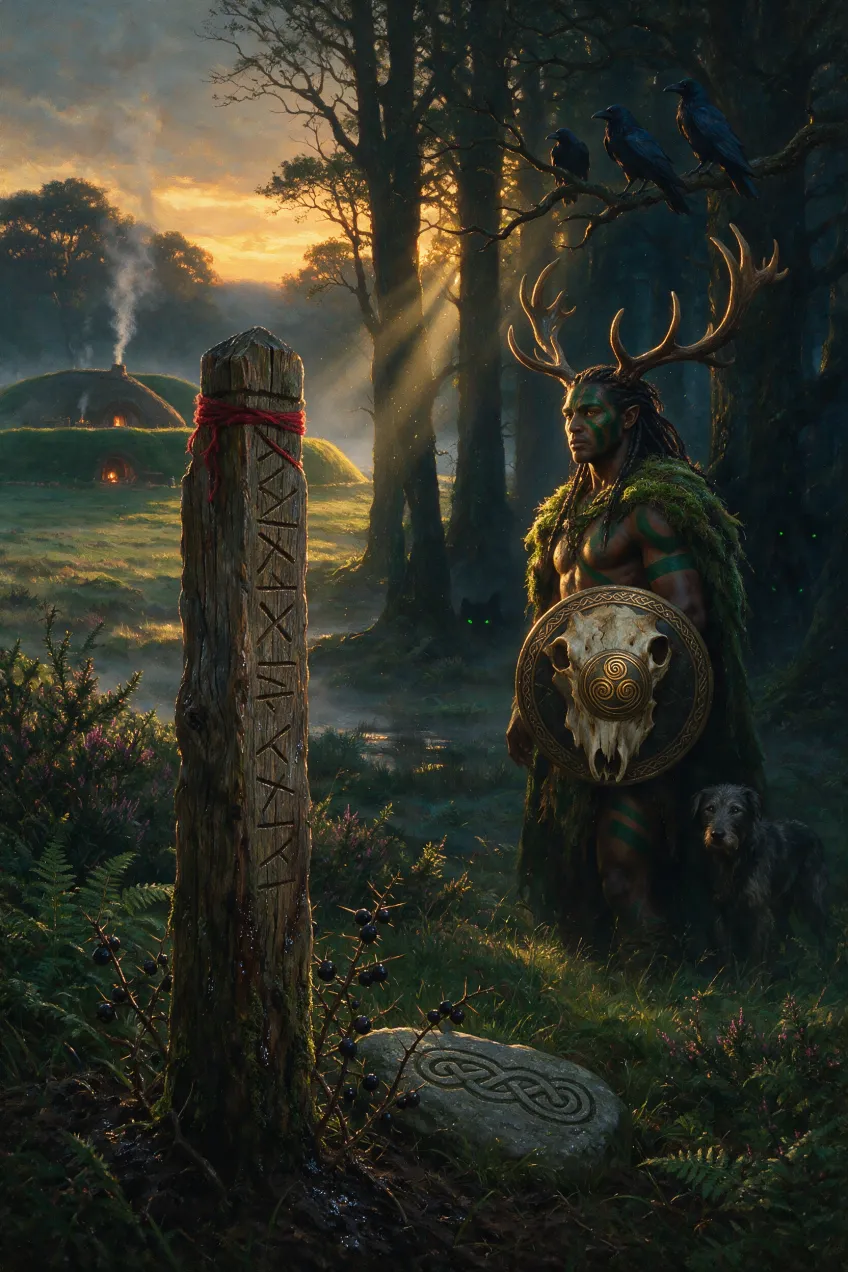
The Antlered Warden
Name what may not cross, and I'll hold the line till the hill wears down. Name everything — and what you've built is a cage.
Who they are
The guardian at the eaves of the dark oak wood, where the rath's fields end and the wild begins — a mature warrior grown half into stag, antlers branching against the last light, deep-forest-green markings on his skin, a heavy moss-cloak instead of wings, because a boundary does not fly away from its post. His shield is a stag's skull bossed with a triskele; a hound waits in the bracken, wolf-eyes in the dark beyond, three ravens on watch in the oaks. The antlered ones are older than both courts — smiths were hammering an antlered lord into silver two thousand years before anyone thought to write his name — and old things get the old jobs. His is the oldest: the edge.
Drawn upright — the teaching
Some things are yours to protect — your peace, your people, your line in the sand — and protecting them is not aggression. A boundary is the fence that lets the field grow, the wall that makes a hearth possible. People without edges don't become open; they become overrun.
The working
Drive a rowan or oak stake at the real edge of what's yours — the gate, the desk, the hour of the evening that belongs to your family — and say aloud, once, what may not cross it. Once. One stake, one sentence, no speech: "Work does not come through this door after six." "Her opinions stop at this gate." The rowan wards, the oak holds, and the plainness is the power — a clear boundary named calmly is a kindness, not a threat — now everyone knows where the line lies. Renew it once a year and otherwise let it stand.
Drawn reversed — the shadow
Your guarding has curdled into menace. Everyone gets treated like a threat now — the stranger and the friend alike — and you'll drive off the people who love you along with the ones you feared. A warden who suspects the whole world has stopped guarding the gate. He's guarding his wound.
The undoing
Lay the shield down — physically set down something you carry braced, and notice what your shoulders have been doing for years. Then look hard at who is actually at your gate. Name the friends aloud as friends: "You. You're not a threat. Come in." And open the gate all the way. Not everyone at the edge came to take from you; some have stood out in the cold a long time, waiting to be recognized.
Its tree · the ogham
Duir — the oak, cut as a warding-post. The hardest wood on the hill takes the boundary duty so the softest things inside the ring — the child, the hearth, the sleep — never have to harden at all. That is what the hardness is for. It was never for the people inside.
Sit with this
Who's at your gate that you've been treating like a thief? And when did you last walk out of your own gate unarmed?