The Blackthorn Gate
Everyone who forced me bled. Everyone who asked walked through untouched. It was never about the thorns.
Who they are
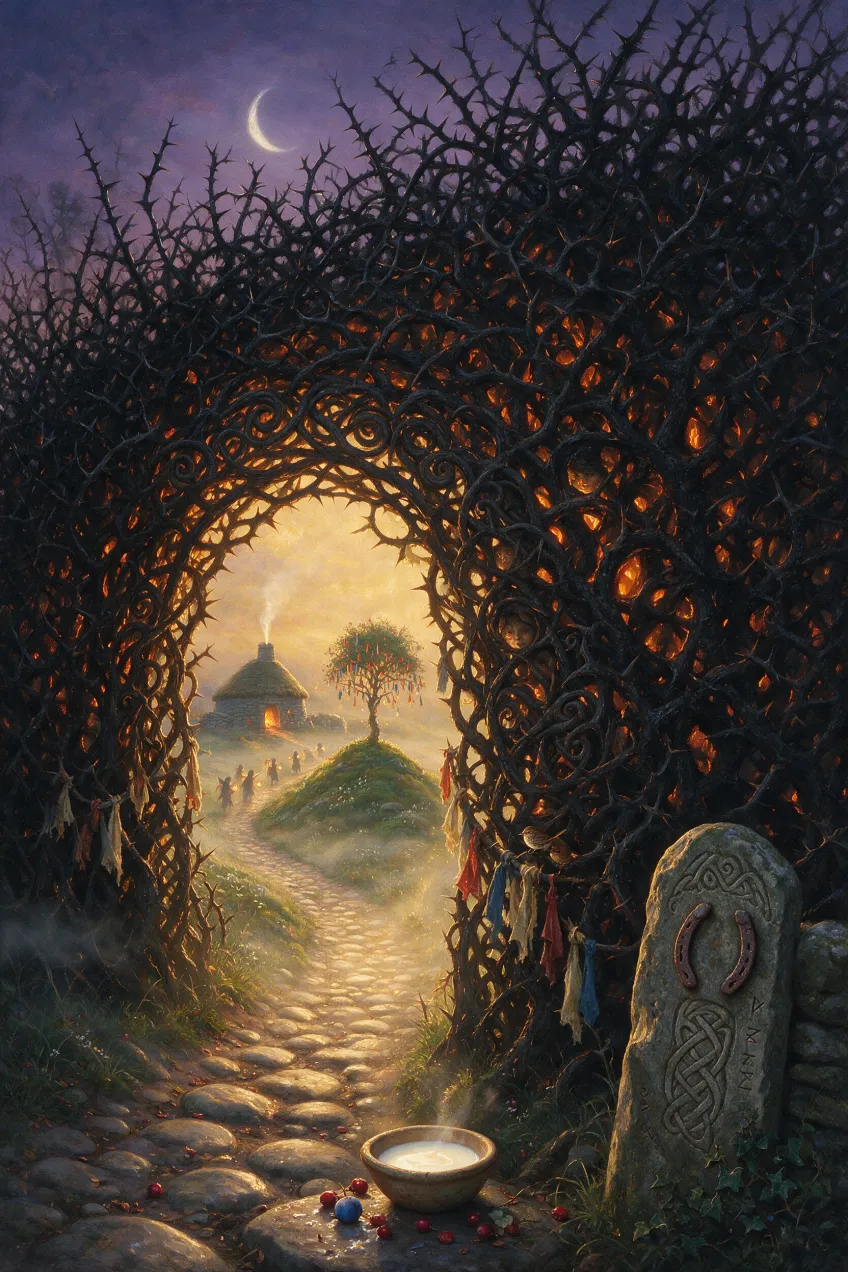
An arched gap in a towering ancient blackthorn hedge at Samhain twilight — thorn massed into a black wall higher than a house, the orange under-bark glowing deep in the weave like coals in a banked fire. Through the arch, a fairy-path worn smooth in the grass runs on into gold mist; past the gate stand a hawthorn mound and a turf broch, waiting. Straif is cut into the gatepost-stone. On the post hangs a rusted horseshoe — iron, the one courtesy every door in the Otherworld respects — with rag-cloots knotted beside it and a milk bowl set at the foot. The old country knew gaps like this one: the fairy-paths ran straight, the gates sat where they had always sat, and the family that built across one learned, expensively, why you don't. This is the hedge's one honest door — the wall made passable, on terms.
Drawn upright — the teaching
There's a way through the wall in front of you — the closed profession, the shut family, the impossible person — but only if you come the right way. Force has already failed; that's how you know this is a gate and not a gap. The barrier was never built to stop everyone. It was built to stop everyone who won't ask.
The working
Stop at the thorn-arch — before the interview, the reconciliation, the ask. Stop fully; feet still. Then ask leave, aloud: "May I pass — I come honest." And come honest: empty of tricks, no leverage in the back pocket, no rehearsed angle, because this gate reads pockets. Pay the door its courtesy — touch the horseshoe iron, or carry a nail as respect, not threat — and walk through at the pace of someone with nothing to hide. The gate that stops everyone opens on its own for the one who asks. It always did.
Drawn reversed — the shadow
The same wall that keeps trouble out can lock you in. A rule, a role, a relationship can protect and imprison with the very same thorns — and from inside, safety and captivity share a fence-line so exactly that most people can't say which side of it they live on.
The undoing
Walk to the gate and test it — actually test it: make the ask you're never allowed to make, take the evening that's never yours to take, say the honest thing the role forbids — and watch what the wall does. If it only ever opens outward for others and never for you, it isn't protection; it's a cell. Name which yours is, out loud. Then unlatch the side that's keeping you in: the boundary can stay — the lock on your side comes off.
Its tree · the ogham
Straif — the blackthorn, gate-form. The strife-letter keeps this arch, and it gets the clan's last word: the thorn was never the enemy. The manner of approach decides everything.
Sit with this
What wall are you still trying to force? And which of your own walls would fail the test — opening for everyone's needs but never for yours?