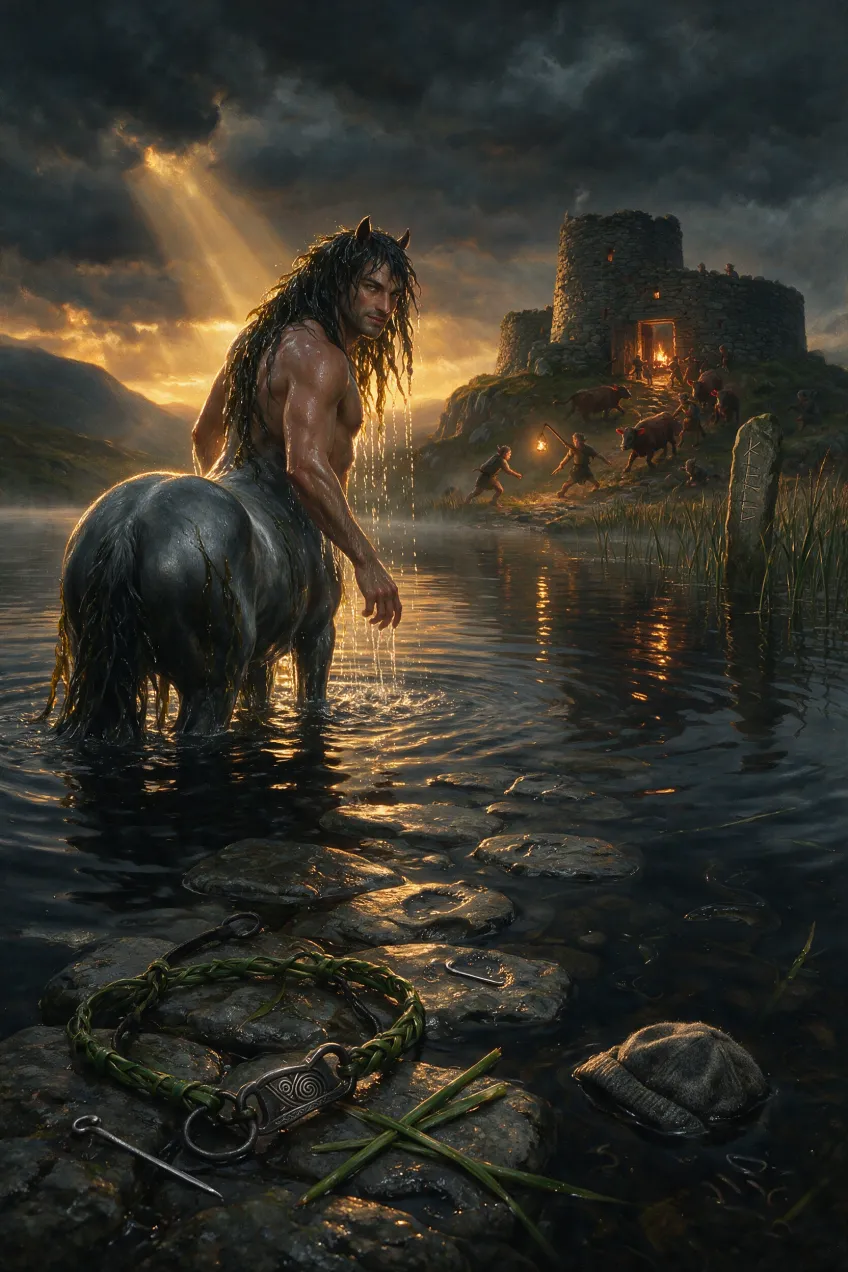
The Kelpie
I am the finest horse you will ever see. That part is true. The question was always who holds the bridle.
Who they are
The water-horse of the black lochs — kelpie in the Lowland mouth, each-uisge in the Gael's — and the grandmothers did not tell his story to be charming. At the lochside at dusk he is the most beautiful horse anyone has ever seen, saddle-broke and patient; his skin holds like tar, and the riders who mounted uninvited went down and did not come back up. But the same tradition keeps the other half of him: bridle a kelpie with cold iron and you have harnessed the strength of ten horses — the old tales tell of lairds who worked a bridled water-horse hauling stone. Kelp-maned, storm-grey, man-shouldered above the horse of him, he waits at the black lochan under the dun, and his emblem is the bridle of woven reed and cold iron — the only thing that ever tamed him. It works.
Drawn upright — the teaching
There's a wild force in your life — desire, ambition, a person, a pull — that can carry you further than anything tame ever will. That's real, and don't let the timid talk you into ponies. But it carries you only if you master it first. Passion inside a hard limit builds kingdoms. The same passion without one is just drowning with better scenery.
The working
Bridle it with cold iron before you ride — set the hard limit before you ever touch the thing; iron is the one thing that holds a kelpie, and a limit set in advance is the only kind that holds a human. Say it out loud, specific, beforehand: the sum you will not pass, the line that will not be crossed, the hour the work stops, the drink that is the last. Say it with a piece of iron in your hand — a nail, an old key — and keep that iron where the riding happens: pocket, desk, doorframe. Then ride. Hard, gladly, no half-grip. Keep your grip and your iron and you ride it clean.
Drawn reversed — the shadow
You climbed onto something beautiful and now it won't let go. The thrill had your name on it from the start — that is how the lure works — and the skin has hold of you: the habit, the person, the bet, the pace. And it is not standing still. It is walking, calmly, toward deep water.
The undoing
Cut the tack. Get off while your feet still find bottom — now, at this depth, not the next one. Cancel the card, hand back the key, say the ending sentence. Then leave the cold iron between you and the water: the standing rule, the deleted number, the one person told to hold you to it. The old stories are unanimous: once a kelpie has you past the deep, no bridle helps. So the whole working is one word — now.
Its tree · the ogham
Fearn — the alder. The shield-tree: the old smiths cut their shields from alder, the wood that takes the blow at the front of the fight. Iron in one hand, alder on the arm — the limit and the guard, both set before the battle. Never during.
Sit with this
What are you riding right now — and did you set the limit before you mounted, or are you inventing it mid-river?