The Passage Tomb
The dead built me to catch the light. Mind you use me the same way.
Who they are
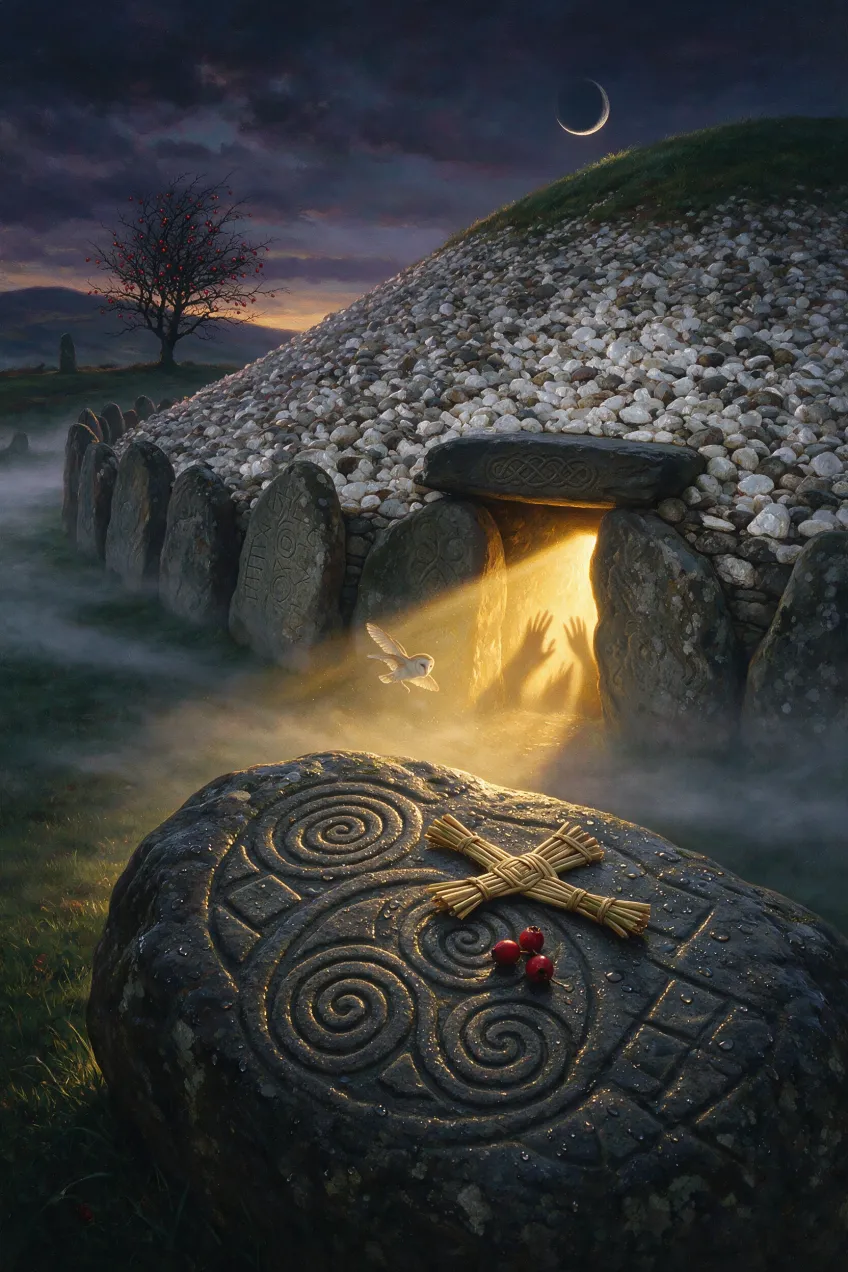
A great mound of white quartz and grey cobble at Samhain twilight — carved kerbstones in a ring, ground-mist, a bare haw-red hawthorn, one low doorway glowing faint gold down the passage. These are real houses of the dead: the passage tombs of the old country were raised before the pyramids, and their builders aimed the whole mountain of stone at a single morning — a roof-box cut above the door so that one midwinter sunbeam walks the length of the passage and lays its gold on the chamber floor. When the old gods went under the hills, mounds like this became the sí — and the oldest court of the Good Neighbours is the ancestral dead. The door is low on purpose. You bow going in.
Drawn upright — the teaching
You are close to the wisdom of those who came before you — the veil is thin, the deep knowing near. The answers you've been hunting — about your family, your patterns, what to do next — are partly already held by your dead. This is the season they can hand things across.
The working
Enter the tomb the way the builders meant. Go at the turning of the year — Samhain into midwinter — to somewhere old and quiet, in silence: no requests yet, phone dark. Bow at the low door, actual or imagined; humility is the admission price. Then let the one shaft of solstice light find the dark chamber — sit in the dark you carry until something not-yours lights it: a memory surfacing, a sentence arriving in their voice, a knowing with no source. Leave a door-offering on the threshold as you go — an apple. Come with real reverence and the past will speak to you. It has been waiting for the light to be let in.
Drawn reversed — the shadow
You've sealed yourself in with the past — old memories, old ways, the dead — behind a door that only opens inward. A history that entombs the living isn't reverence. It's a grave you climbed into.
The undoing
Roll the stone back. Let the solstice light and the outside air in — literally: open the curtains of the kept room, unbox the boxes, tell the story to someone young instead of re-reading it alone in the dark. Then walk out into the living year and put one foot in its calendar: something planted, booked, begun. Visit the tomb for its wisdom — the builders did, once a year, when the light came. Don't move in.
Its tree · the ogham
Iúr and Ruis together — the yew at the kerb, the elder at the gate. The ogham's two ending-trees, keeping this one door between them: yew for the long memory that stays green, elder for the passage handled with respect. A door flanked by both is saying a single thing — an ending honored on both sides becomes a door.
Sit with this
When you visit your past — and you should — who decides when you leave: you, or it?