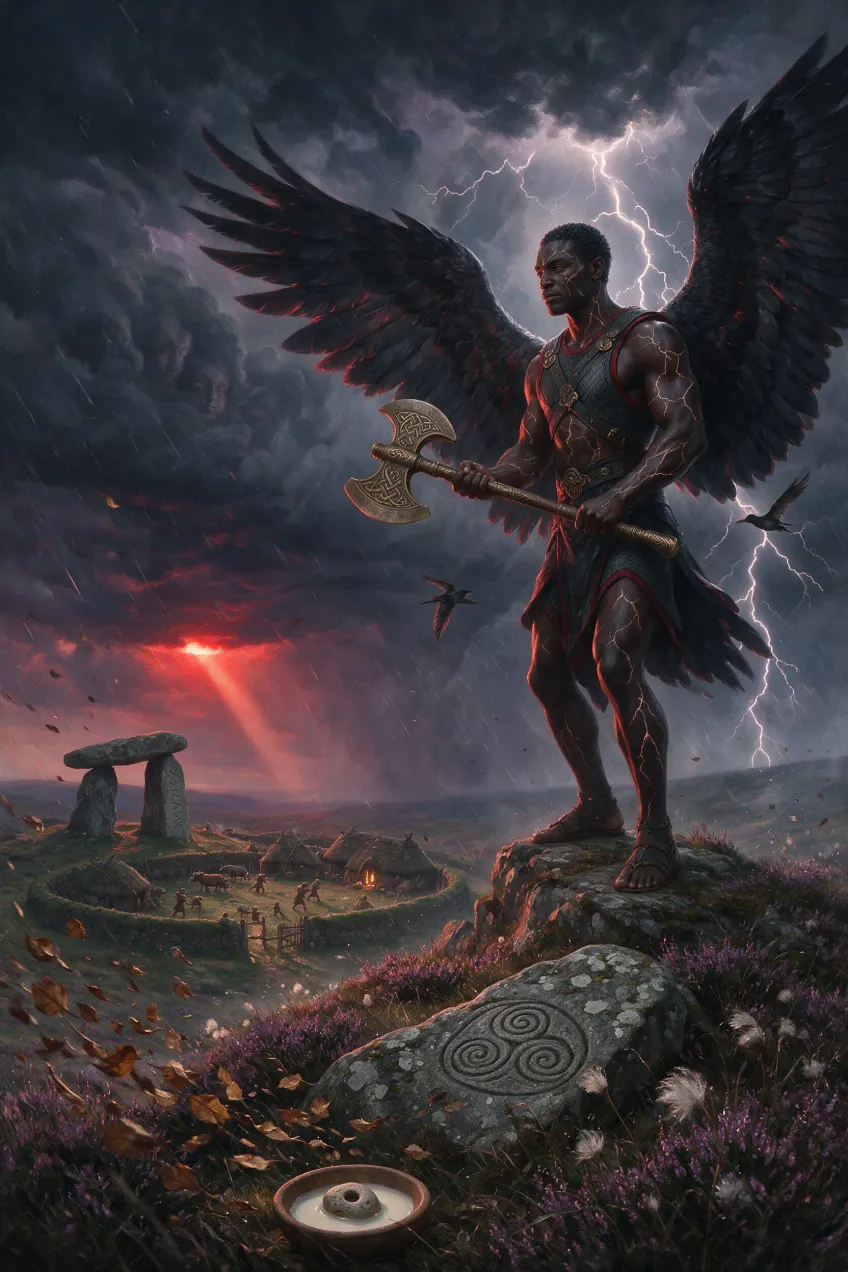
The Storm-Herald
I never send a storm unannounced. I send the birds home first. Who taught you not to look?
Who they are
A mature warrior of the high air — charcoal-skinned, lightning-scarred, mantled in black storm-petrel feathers edged with crimson; thunder-kin from a far storm-country, standing his watch on the bare tor beside the dolmen. The petrel is his bird for a reason: sailors knew that when the little storm-birds came dancing down the wave-troughs, weather was already on the road. Around his boots the Gaoth Sidhe — the fairy-wind, the sudden gust out of a clear still day — scatters ash leaves. He carries a double-headed thunder-axe he almost never uses. A herald's power is not the storm. It is the hour's warning.
Drawn upright — the teaching
You can feel what's coming before it lands — so read the signs. The pressure drop in a marriage, the strange quiet in a workplace, the tightness in your own chest that arrives before the trouble does. Most people can feel weather coming and have trained themselves not to look, because looking means having to act. That is the whole difference between the ones a storm flattens and the ones it merely soaks: not luck. Readiness.
The working
Watch the sky the old way. The birds going quiet. The cattle turning their tails to the wind. The leaves showing their pale undersides. In your own life those signs have names: the friend gone short in their answers, the account running thinner each month, the meeting that keeps being moved. When you read them, act before the break — batten what's loose: the paperwork, the savings, the spare key, the hard conversation had early while it's still cheap. Then warn your people; a herald who keeps the warning to himself is just a spectator. Say it plainly: "Weather's coming. Here's what I see." Meet it prepared and you weather it standing.
Drawn reversed — the shadow
This is change as pure destruction — leveling everything, feeling nothing, leaving no ground fit to rebuild on. Somebody here — maybe you — has stopped clearing and started swinging, and is calling the wreckage transformation. Not all upheaval is growth. Some of it is just an axe that likes the sound.
The undoing
Stop swinging. Put the axe down where you can see it, and pull the people you love out of the blast — in words: "This was never meant to land on you." Then answer the herald's one question: what are you actually trying to build? If you can't answer it, you weren't clearing ground — you were having a tantrum with weather attached. Within the week, raise one thing where something came down: a plan, a repaired conversation, a planted bed. Building is the only proof the felling had a purpose.
Its tree · the ogham
Nion — the ash. Three of the five great guardian trees of old Ireland were ash — trees whole territories stood behind — and the old rhyme warns that the ash courts the flash: it stands tall on the open ridge and takes the strike. Spear-wood, storm-wood. The tree that holds the high ground knows the weather first, and pays for the knowing.
Sit with this
What storm can you already feel coming — and what would battening down actually look like, this week? And the last time you tore something up: what did you build after?