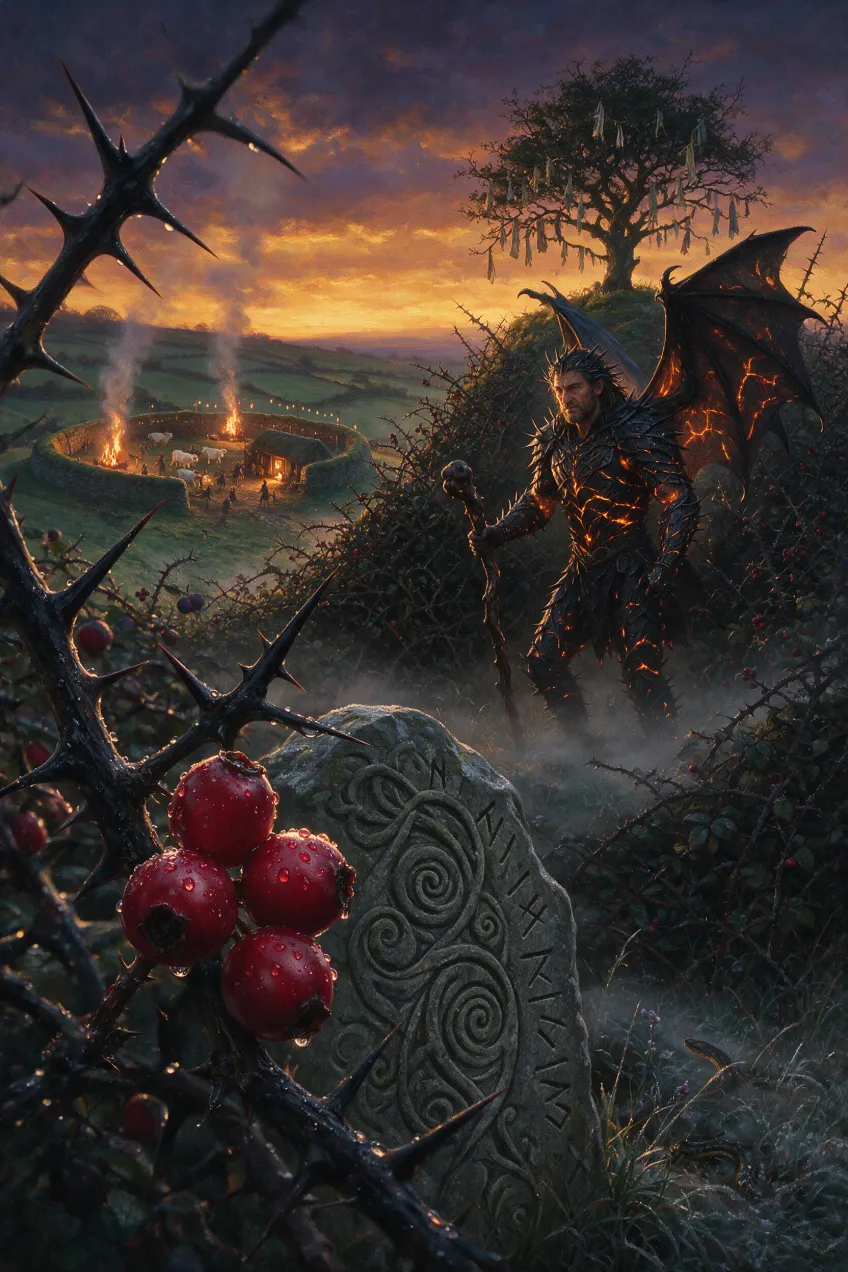
The Thornwarden
Every thorn on an honest hedge points at the road. The day yours turn inward, come find me.
Who they are
The soldier of the hedge — armored in blackthorn spine, with the orange under-bark glowing at his joints like banked coals, because under its black skin the blackthorn burns orange; cut one and see. His wings are dark ragged membrane veined with that same ember light. He walks the thicket that rings the lone hawthorn on the mound at Samhain dusk, cudgel in hand — the shillelagh, the blackthorn stick that settled more arguments in Ireland than any sword. The old country walled itself in living blackthorn: hedges that turned cattle, raiders and weather for centuries, and the tradition is firm that the thorn has its own fierce guardians who take it hard when it is cut out of season. He is that firmness with a face, and he has never apologized for the spines: everything soft in the hedge is alive because of them.
Drawn upright — the teaching
Boundaries pointed the right way — outward — are what let you stay open-hearted and safe. The no you finally say, the door you finally lock, the limit you finally mean: none of it makes you cold. It makes you fit to be close to. People with no hedge at all aren't open; they're overrun. Good walls don't shut you off. They make it safe to let people in.
The working
Plant a blackthorn at your gate if you have ground; if you don't, set a cut thorn-branch over the door or along the fence — spines facing the road, always the road. Ask the tree's leave before you cut, and never cut on the old fairy days — the eleventh of May, the eleventh of November — when the thorn's own guardians walk. Pay at the roots: a splash of milk, a heel of bread. Then say once, plainly, what the thorn is for: "Guard this gate. Trouble stays on the road; my people come through." No thank-yous — bless instead: "Blessings on the thorn and the hand that leaves it standing." Then live like you meant the second half: let your people through.
Drawn reversed — the shadow
You've grown the hedge so thick nothing gets through — not the people who'd hurt you, but not the ones who'd love you either, every thorn turned inward. You call it self-protection. Count the visitors. A wall that admits no one isn't guarding a life; it's fencing an emptiness.
The undoing
Cut one clear gap in the wall — with asked leave, on purpose, wide enough to walk through — and turn the thorns to face the road again. Then make the gap real: name the one person it's for, and have them through it inside the week. A hedge is meant to guard a garden, not bury it.
Its tree · the ogham
Straif — the blackthorn. The strife-letter, the hedge-tree of the old country — black skin, orange heart, spines that turn everything but the wren. Its teaching is direction: the same spine is mercy or menace depending on which way it points.
Sit with this
Which way do your thorns face — honestly? And who last came all the way through your gate?