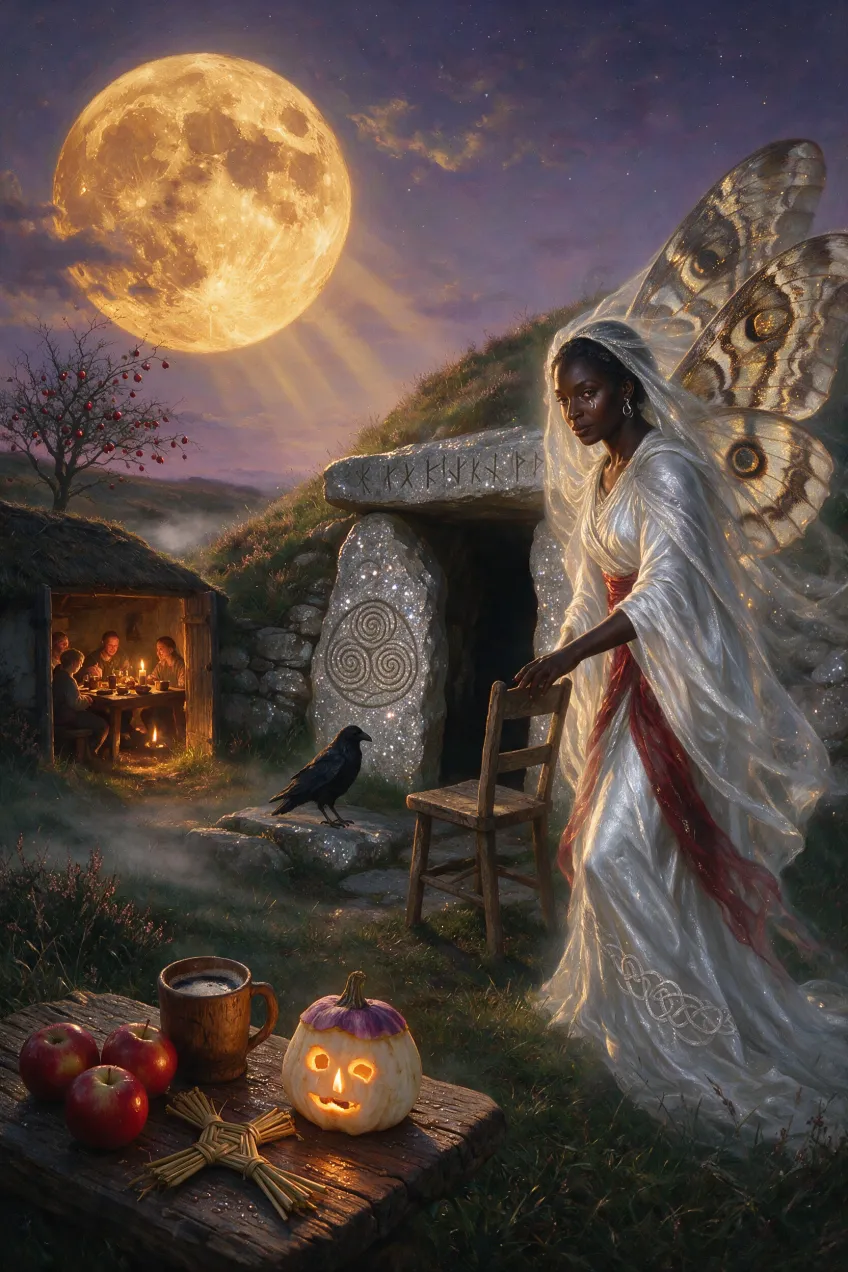
The Weeping Lady (White Lady of the tomb)
Pour the ale and say my name. Then — I mean this with love — go home and live.
Who they are
The White Lady of the tomb — spectral silver and white against deep dark skin, a scarlet thread of weeping beneath each eye, veiled in the translucent shimmer of a death's-head moth. White Ladies are seen the length of the old countries — at raths, ruins, and tomb-fields — and the tradition reads them truly: they are not malice. They are love that would not put the vigil down. At Samhain the dead were expected home: floor swept, fire banked, the table laid, a chair left empty, and in many houses the dumb supper — the meal eaten in full silence so the returning could join it. She keeps that table from the other side, at the tomb door at moonrise, beside the apples, the ale, the empty chair. Devotion made visible. Which is the honor, and the warning, both.
Drawn upright — the teaching
Love that outlasts death is holy. Keeping a memory faithfully — the chair still set, the birthday still marked, the name still spoken in the house — is not morbid; it is one of the oldest right things humans do. Grief honored this way ripens, over time, into grace.
The working
Keep the ancestor-altar the old way, at Samhain above all. Set the empty place at your table. Pour the dark ale — or the tea they actually drank — and set out an apple. Speak their name aloud, plainly, to them: "There's your chair. You are remembered in this house." If you keep the dumb supper, keep it whole: the meal in silence, the door on the latch. And then — this is the law of it — clear the table when the evening ends. Let devotion be a visit, not a residence: you sit with them for an evening. You do not move in.
Drawn reversed — the shadow
Faithful devotion has curdled into a haunting — grief turned prison, regret chaining you to a door that closed years ago. It's you keeping vigil at the tomb now. And the living can't reach you there.
The undoing
Keep the memory; stop living at the tomb. Go to the altar — or the grave, or the photograph — and say the goodbye you've been refusing, out loud, all of it. Then blow out the vigil-candle yourself; don't wait for it to gutter. Walk back into your own life and do one living thing the same day — a meal cooked, a friend sat with. Honoring the past is love. Living inside it is a cage you can still leave — and she would tell you so herself.
Its tree · the ogham
Ruis — the elder. The crone-tree the old people set at graves and thresholds — keeper of the doors between. It flowers for the weddings and fruits for the wakes and never once confuses the two. That is the whole art she teaches: love your dead, and know which side of the door you live on.
Sit with this
Whose chair are you still keeping — and when did you last sit down in your own?