Wild Law
Take whatever you like. Everything here is for sale — and no one leaves without paying.
Who they are
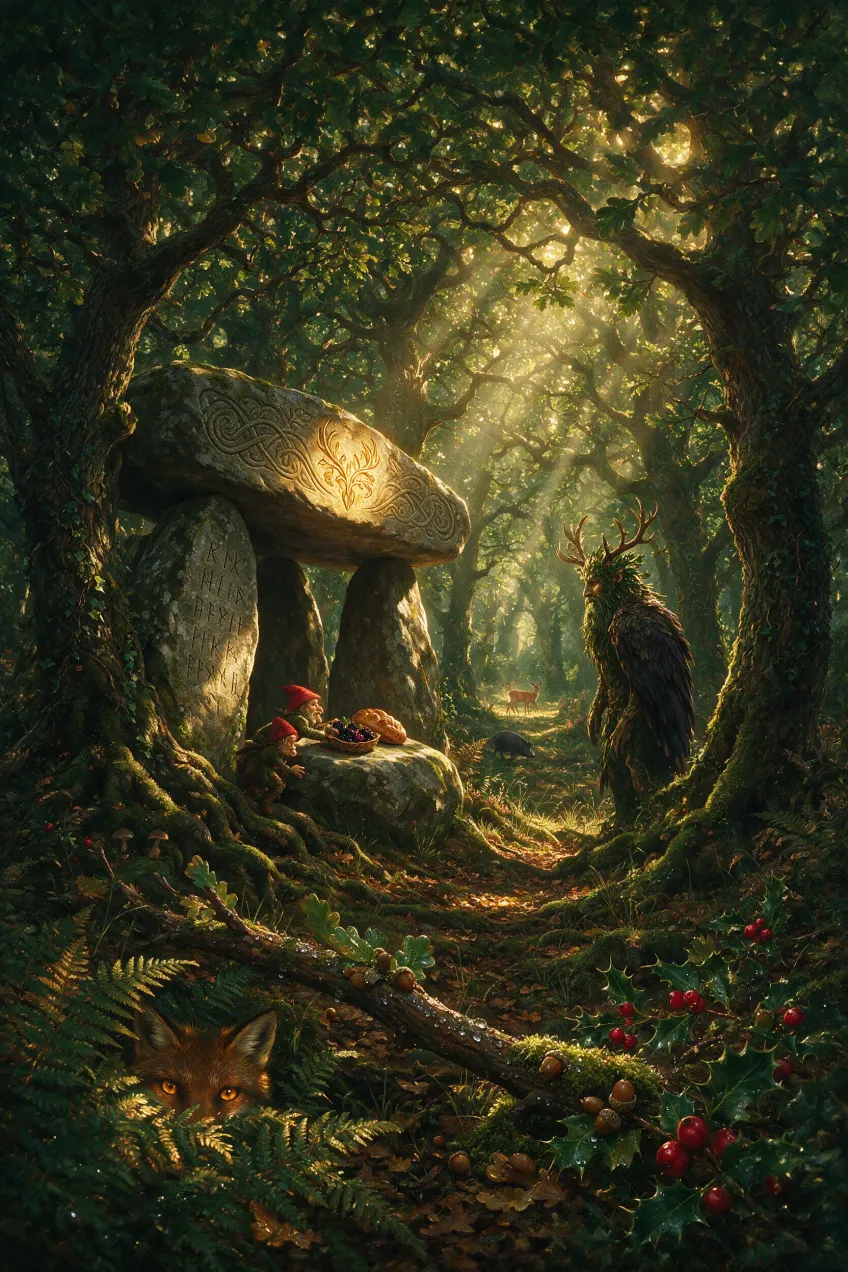
The Green Man — the oldest face in the wood, oak-leaf and antler where a man would have hair and crown, a buzzard-feather mantle across his shoulders. He belongs to neither court; Seelie and Unseelie both bow to what he keeps. And what he keeps is the first arithmetic of the Otherworld: absolute, exact reciprocity. Every gift carries a debt. Every taking has a price. Even the dolmen behind him — a king's tomb once — is being slowly repossessed by the roots. Monuments pay rent here. So do you.
Drawn upright — the teaching
Life runs on give and take, and it was running on it long before your plans. This is not karma as a mood — it is bookkeeping. Take only what you can honor and the wild keeps feeding you; the people, the land, the work all keep feeding you. Honored taking is the whole secret of a life that doesn't run dry.
The working
Before you take anything from the land — a branch, a berry, a stone — leave something back in its place and say why you came. Carry payment for the purpose: a pinch of oats, a splash of milk, a strand of your own hair if that's all you have. Say it plainly: "I need this branch for my fire." Never take the last of anything — the last berry on the bramble, the last flower on the bank; the last of a thing belongs to Them. And keep the old etiquette: no thank-yous — a thank-you admits a debt and hands over your power. Bless instead: "Blessings on the giver and the ground."
Drawn reversed — the shadow
You've been taking without asking — from the land, from people, from your own body — and assuming no one is counting. Something always is. The ledger doesn't send reminders; it just sends the bill, and it comes due in full.
The undoing
Pay the debt, with interest. Give back more than you took — to the one you took it from if you can, to the next in line if you can't: hours for hours, money for money, rest for what you stripped from your own body. Say what the payment is for as you make it: "This clears what I owe." The Otherworld forgives a debt paid — never one denied.
Its tree · the ogham
Fearn — the alder. White wood that bleeds red the moment it's cut — the tree that shows you, honestly, what taking costs. Yet whole lake-dwellings stood for centuries on alder piles driven into dark water: pay the tree fairly and it will hold your house up and never say a word.
Sit with this
What are you taking, right now, that you haven't paid for? And who — or what — is quietly keeping the count?